
Sine Wave Generator
Description:
A classic Wien Bridge oscillator using an Op-Amp covering a frequency range of 15 to 150kHz in four switched steps.
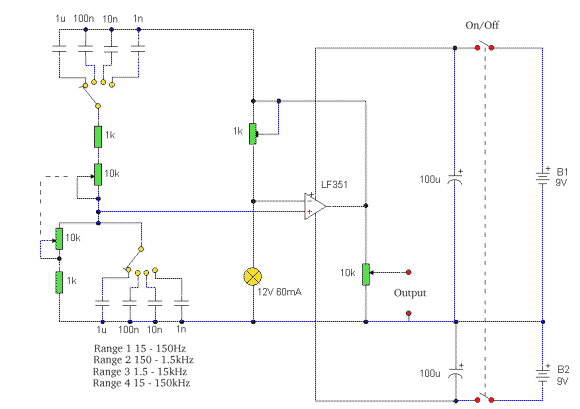
Notes:
Two conditions exist for a sinusoidal oscillator. Regenerative or positive feedback, and a closed loop gain of unity. The losses in the wien feedback circuit, are such that the open loop gain of the amplifier must also exceed 29. The following link also provides the wien oscillator theory:
Wien Oscillator Theory
In this circuit the gain is provided by a FET type op-amp. I have used an LF351, which may be hard to obtain, but the TL071CN or TL081CN may be used and have a faster slewing rate than the LF351. The Maplin order codes are RA67X and RA70M respectively. The wien network is a parallel combination of resistor and capacitor, in series with a serial R-C network. Regenerative feedback is applied from the op-amp output, to the serial R-C input and continues. Stabilization is required to prevent the otherwise uncontrolled oscillation from building up and becoming unstable.
Stability and Distortion
There are two common methods of stabilizing a wien type oscillator. A thermistor with a NTC in the series leg of the feedback loop or an incandescent lamp (with a positive temperature coefficient) in the shunt leg of the feedback loop. The bulb used here is a 6V 60mA type Maplin
code BT99H. A 12 Volt bulb rated 60mA or
40mA will also work. The feedback
arrangement works as follows. As a bulb
heats up its filament resistance
increases. This will decrease the
overall gain of the amplifier, as the
output signal is fed back to the input.
Similarly, if the output amplitude
decreased the signal appearing at the
bulb would be less, its filament
resistance would drop and gain would be
increased. Therefore a stable output
amplitude is produced. The 1k preset is
adjusted for minimum distortion. Note
that split supplies are used and a
ganged 10k potentiometer controls
frequency with a 10:1 range