
Torque versus Speed
An important consideration in designing high-speed stepping motor controllers is the effect of the inductance of the motor windings. As with the torque versus angular position information, this is frequently poorly documented in motor data sheets, and indeed, for variable reluctance stepping motors, it is not a constant! The inductance of the motor winding determines the rise and fall time of the current through the windings. While we might hope for a square-wave plot of current versus time, the inductance forces an exponential, as illustrated in Figure 2.10:
Figure 2.10
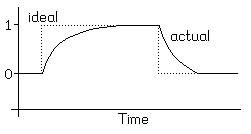
The details of the current-versus-time function through each winding depend as much on the drive circuitry as they do on the motor itself! It is quite common for the time constants of these exponentials to differ. The rise time is determined by the drive voltage and drive circuitry, while the fall time depends on the circuitry used to dissipate the stored energy in the motor winding.
At low stepping rates, the rise and fall times of the current through the motor windings has little effect on the motor's performance, but at higher speeds, the effect of the inductance of the motor windings is to reduce the available torque, as shown in Figure 2.11:
Figure 2.11
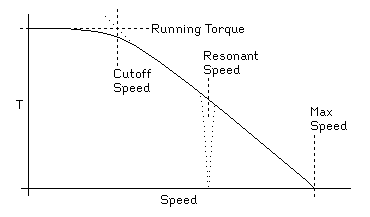
The motor's maximum speed is defined as the speed at which the available torque falls to zero. Measuring maximum speed can be difficult when there are resonance problems, because these cause the torque to drop to zero prematurely. The cutoff speed is the speed above which the torque begins to fall. When the motor is operating below its cutoff speed, the rise and fall times of the current through the motor windings occupy an insignificant fraction of each step, while at the cutoff speed, the step duration is comparable to the sum of the rise and fall times. Note that a sharp cutoff is rare, and therefore, statements of a motor's cutoff speed are, of necessity, approximate.
The details of the torque versus speed relationship depend on the details of the rise and fall times in the motor windings, and these depend on the motor control system as well as the motor. Therefore, the cutoff speed and maximum speed for any particular motor depend, in part, on the control system! The torque versus speed curves published in motor data sheets occasionally come with documentation of the motor controller used to obtain that curve, but this is far from universal practice!
Similarly, the resonant speed depends on the moment of inertia of the entire rotating system, not just the motor rotor, and the extent to which the torque drops at resonance depends on the presence of mechanical damping and on the nature of the control system. Some published torque versus speed curves show very clear resonances without documenting the moment of inertia of the hardware that may have been attached to the motor shaft in order to make torque measurements.
The torque versus speed curve shown in Figure 2.11 is typical of the simplest of control systems. More complex control systems sometimes introduce electronic resonances that act to increase the available torque above the motor's low-speed torque. A common result of this is a peak in the available torque near the cutoff speed.