|
An analogue signal is similar to a sine wave and is generally less than 5v (5,000mV) in amplitude. Low-level signals are generally expressed in mV, to make them instantly recognisable and easy to talk about.
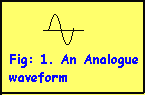
Fig: 1shows an analogue signal. It may be as low as a few millivolts or hundreds of millivolts. In general this type of signal will be too small to be detected by a microcontroller. A micro needs a signal greater than about 3,500mV so that the waveform appears on the input line as a HIGH, during the peak of its excursion. It should be as high as 5,000mV as possible for reliable detection of the signal. The instruction to "read" the HIGH is:
BTFSS 06,3 ; Test input line GP3
This instruction tests line GP3 and if the bit is HIGH (the line is SET - the line sees a HIGH) the micro will skip the next line in the program and execute the line that follows in the program.
The shape of the waveform does not matter. It can consist of large excursions and small excursions as shown in fig: 2.

Only the large excursion(s) will be detected by the micro as the others may be too small to be detected. To increase the analogue signal to as high as 5,000mV as possible, an amplifier is needed, as shown in fig: 3.

The amplifier maybe one or two stages, depending on the amplitude of the original signal.
Each stage of an amplifier will increase the size of the signal about 70 times. If you are very lucky, you may get an amplification of 100x (100 times). Thus a 5mV signal with one stage of amplification will produce a 350mV signal. This is not sufficient to be detected by the micro. Another stage will easily produce a full 5,000mV signal and the micro will detect its presence.
The second stage only needs to amplify the signal about 10 to 12 times to be sufficient for the micro, and the added gain provided by the stage simply drives the waveform into "bottoming" and "cut-off" as shown in fig: 4.

This means the waveform will be "clipped" at the top and bottom and converted to a fairly "square-ish" shape. Normally this would be called distortion but in digital terms we don't worry about it being distorted and simply use it for its "triggering" properties.
Suppose you have a waveform that is higher than 5mV (say 30 - 50mV) and want to know if it will trigger the micro after a single stage of amplification.
Connect the circuit in Fig: 5 to the micro and connect a LED with 470R resistor in series, to pin GP0.
Burn the following routine into a PSEUDO'508 and the LED will illuminate when the waveform is detected as a HIGH.
Program for a Pseudo'508:
BSF 03,5 ;Select Page1
MOVLW 08 ;GP3 input
TRIS 06 ;Load TRIS
BCF 03,5 ;Select Pag0
Test1 BTFSS 06,3 ;Test input line
GOTO Test2
BSF 06,0
GOTO Test1
Test2 BCF 06.0
GOTO Test1
There is only one problem with the circuit in Fig: 5.

At the end of a whistle or speech, the LED may be illuminated or extinguished. It all depends on the last cycle of the waveform. The circuit sits with the output approx mid-rail and the micro does not know if this is a high or low, and takes the reading by the direction of the last cycle.
Some of the inputs of the micro are Schmitt Triggered. This means a HIGH has to be 85% to 100% of rail voltage for it to be seen as a HIGH and between 20% and 0% to be seen as a LOW.
The non-Schmitt Trigger inputs see a LOW as 20% to 0% and a HIGH as above 2v for 5.5v operation.
If the last cycle went from zero to mid-rail the micro will see the waveform as a low on Schmitt Trigger inputs and a HIGH on the other inputs. If the cycle came from a high to about mid-rail, the waveform will be seen as a high. This problem can be overcome via a few instructions in the program, by looking at the input and if it is not changing, it is ignored. Suppose the circuit only just activates the micro with a loud whistle. To improve the sensitivity of the input another stage will be needed.

This can be a DIGITAL STAGE as shown in fig: 6 or an analogue stage as shown in fig: 7.
A digital stage simply means the biasing resistor is left off the base of the second transistor so the transistor turns on fully when a signal greater than 650mV is detected and is fully turned off at other times. This stage is ideal for the micro as only two voltage levels are delivered. Either 0v or rail voltage (5v).The other advantage is the stage does not take any quiescent (idle) current.
This stage is only suitable if you are sure you have plenty of "over-voltage" to drive the transistor into saturation. By this we mean you must have at least 1v (1,000mV) drive signal so you can be sure the transistor will turn on (saturate).
The fast rise and fall times means you have a "clean" period of time during a HIGH or LOW for counting operations. A micro determines the frequency of an incoming signal by counting the length of time for the HIGH or LOW (between a rise and fall) and coming to a decision as determined by the program. If the lengths of the HIGHs and LOWs are very regular the micro can come to an accurate decision very quickly. This is very important if you are detecting a particular frequency out of a possibly range of frequencies as the program will compare the incoming frequency with a table value and it may keep sampling until an exact match is produced.
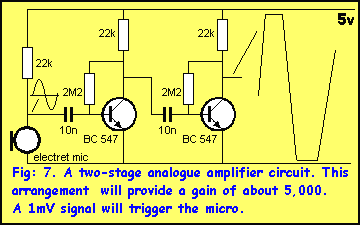
Fig 7. Shows two analogue stages with "over-drive." The circuit produces a signal that is larger than necessary for the micro, and when the input waveform is very low, the output will still be sufficient to trigger the micro.
This circuit is more sensitive than fig: 6 and should be used if you want to pick up faint whispers and turn on equipment (such as a tape recorder). It should also be used for magnetic pick-ups (such as a metal detector, nail finder or pipe locator) as this type of pick up has a very low output (can be as low as 1 to 5mv).
THE PIEZO DIAPHRAGM
Piezo transducers such as piezo diaphragms can also be used as microphones. They produce a very "tinny" sound (like talking into a tin) but this is not important in our case. The output is about the same as an electret microphone (about 10 to 30mV for low level speech and up to 50mV for loud speech).
Some diaphragms are very sensitive while others are very insensitive. You can check the sensitivity with a CRO, by simply whistling and viewing the waveform.
Diaphragms that operate on low voltages, such as those in a music card seem to very sensitive.
The only other way to determine a sensitive piezo diaphragm is to connect it to a music chip. The output it produces reflects its sensitivity as a microphone.
The piezo diaphragm has an advantage over an electret microphone. It does not need a power source.
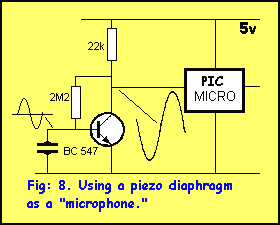
The diagram of fig: 8 shows how to connect it to a transistor amplifier. Using the program above, whistle into the diaphragm and determine if a single stage is sufficient. If not, a second stage, exactly like the microphone stage can be added.
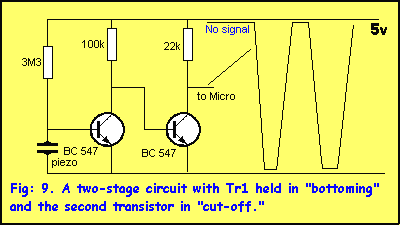
Fig 9 shows a simpler circuit to interface a piezo diaphragm to the input of a micro. The first transistor is held in "bottoming" and the second in "cut-off." This offers the lowest current consumption and produces the greatest output. The second transistor is "turned-off" because the first transistor is "ON" and the voltage across its collector-emitter terminals is about 0.35v and this is below the turn-on voltage of 0.65v for the base of the second transistor. The first transistor is fully turned on but the turn-on current is very low and this allows the maximum waveform to be produced by the piezo for a given sound intensity. In other words the circuit puts the lightest load on the piezo.
When no-signal is present, the output of the circuit is HIGH.
A signal from the piezo produces a full-rail waveform to exactly match the waveform from the piezo.
By monitoring the output of the circuit you will be able to detect the instant the waveform produces a LOW. Instructions that loops until a low is detected are shown below:
Loop1 NOP
BTFSC 06,0 ;Test GP0 for a LOW
GOTO Loop1
The only problem with loop1 is it holds up the micro from doing any other operations.
The solution is to "poll" the input line by producing a program that "looks" at the input on a regular basis and if a low is detected, a "bit" is placed in a flag register. The Main routine constantly looks at the flag register and when the bit is SET, it carries out an operation and cancels the flag.
MAGNETIC PICKUP
A 10mH choke (with both wires coming out the same end so the magnet can pass as close as possible to the core) can be used as a magnetic pick-up to detect rotating shafts etc. The circuit in fig: 10 will connect it to a micro.
Attach a strong magnet to a rotating shaft and have the magnetic sensor close to the magnet as possible without touching. The amplitude of the waveform produced by the coil (choke) will depend on the strength of the magnet, the distance between the magnet and coil, the speed of the rotating shaft and the number of turns on the coil.

Fig: 10 "AC" couples the coil to the amplifying circuit so that the biasing of the first transistor can be determined by the value of the base-bias resistor. The coil cannot be connected directly to the transistor as the low impedance (resistance) of the coil will upset the bias on the base.
If the coil is directly connected to the base, the voltage across the coil will be only a few millivolts and the coil will have to produce 600mV or greater to turn on the transistor.
With our arrangement, 100mV or less will turn off the transistor (a 100mV waveform will turn the transistor ON more during the "positive half" of the waveform and turn it off during the other half of the waveform).
Any coil of wire of any size will be suitable and to make it an effective collector of magnetic flux it should have a magnetic core such as a ferrite.
Simply rotate the shaft at half the required RPM and if the circuit detects the magnet, the coil is suitable. No other impedance-matching or resistance measurements are necessary.
The output of the circuit is exactly the same as for the piezo diaphragm except the frequency will be considerably less.
THE LDR
The cheapest light sensor is the LDR. It has a resistance of about 100 ohms in bright light and more than 1M in darkness.
It can be connected to a transistor amplifier as shown in fig: 11.

The pot alters the sensitivity of the LDR so that the output changes at the desired light intensity. This circuit is only suitable for large changes in intensity. If you need to detect a very slight change in illumination you need a very sensitive detector.
PHOTO DARLINGTON TRANSISTOR
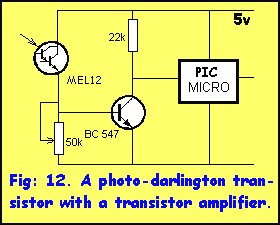
A more sensitive device is a photo-darlington transistor, such as the MEL-12. A further stage of amplification and a pot will adjust the sensitivity level. This is shown in fig: 12.
VOLTAGE LEVELS
Some waveforms change very slowly. They may take a day or so to rise and fall. The are classified as VOLTAGE LEVELS and can be produced by thermocouples (a thermocouple PRODUCES a voltage due to the heating of two different metals in contact with each other). Other devices DELIVER a voltage by being supplied with a voltage and the resistance of the device causes a certain voltage to appear across it. You can call it a VOLTAGE-DIVIDER principle. Devices that deliver a voltage include the thermistor, diode (and transistor) and strain gauge. This is very important as it determines how the device is connected to either an amplifier or the input of the micro.
THE FREQUENCY OF A SIGNAL
Once you have a waveform that triggers the micro (use the test program given at the beginning of this article to make sure it is being detected by the micro) you can get the program to simply detect its presence or determine the frequency.
The frequency can be determined in two ways:
1. Counting the number of HIGHs and LOWs in one second.
2. Counting the time taken for a HIGH-to-LOW transition - one half cycle.
Method 1 is a very slow way to obtain a frequency in cycles per second.
A micro works so fast that it can determine things in a fraction of a second.
Method 2 is much faster but it can be very inaccurate as the half-cycle is multiplied-up to get the value in Hertz. To reduce the inaccuracy you can count 10 cycles or 100 cycles and perform a multiplication. A higher cycle-count reduces the inaccuracy.
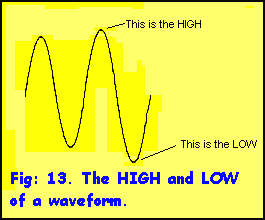
The following steps are required to produce the value of a frequency (in Hertz). Refer to fig: 13 for the definition of a HIGH and LOW.
The input is looped until a HIGH is detected.
The program then goes to a short delay.
The micro comes out of the delay and increments a "count" file.
The program looks at the input for a LOW. If a LOW is not detected the program goes to step B.
When a LOW is detected the program has a value in the "count" file - this is half a cycle.
By adding-up the number of instructions carried out during the "count" increment, the program can work out the frequency of the waveform.
Sometimes a frequency in cycles per second is not required. You may want to compare a frequency with a value in a table. This is called TONE DETECTION.
TONE DETECTION
- also called Tone decoding
The frequency of an incoming tone can be detected and "flagged" when it is exactly the correct tone. This is handy for detecting DTMF tones on the phone line. In this way DTMF tones can be used for turning on equipment (such as lighting, heating, alarms etc). The accuracy of the tone can be set by the program. It is best to allow a margin of error so you can guarantee the tone will be recognised.
For best detection, the incoming tone should be "good quality" i.e full amplitude and free from noise, so the determination can be speedy. Fig: 13 shows a typical waveform.
 |