|
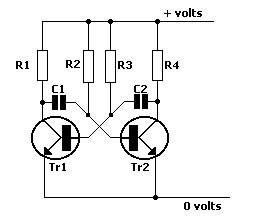
The astable has two unstable states, being unable to rest in a fixed state. When you first switch on, one transistor is on (conducting) and the other is off (non conducting). They stay in this unstable state for a time, determined by a CR time constant. Then the transistors exchange states, the one that was off coming on, and the one that was on going off. They stay in this new unstable state for a time, again determined by a CR time constant, before reverting to the original state.
This process is repeated continuously.
OPERATION
The characteristics of the two transistors are not exactly the same. When the circuit is first switched on, the current through one transistor, say Tr1, will increase faster than the current through Tr2. Due to the rise of current through R1, the voltage across it will increase, causing the collector voltage of Tr1 to fall. This fall in voltage is coupled to the base of Tr2. This causes the collector current of Tr2 to fall, and its collector voltage to rise, due to less voltage being dropped across R4. This rise in collector voltage is cross coupled to the base of Tr1, increasing the forward bias of Tr1 and increasing its collector current. Since the collector current was already rising, its rise is aided by this rising forward bias. The effect is
CUMULATIVE and Tr1 becomes rapidly fully on and Tr2 completely off.
The collector voltage of Tr1 is now low, and that of Tr2 is high. C1 now begins to charge from the supply rail, via R2. As the voltage on the right hand side of C1 starts to rise, Tr2 starts to conduct. Again we have the cumulative effect and Tr2 rapidly comes on and Tr1 goes off. The collector voltage of Tr1 is now high and that of Tr2 low. It is now the turn of C2 to charge from the supply via R3.
As the voltage on the left hand side of C2 begins to rise, the base voltage of Tr1 increases, turning it on and turning Tr2 off.
The whole process repeats continuously. |