|
An operational amplifier, often called an op-amp , is a DC-coupled high-gain electronic voltage amplifier with differential inputs and, usually, a single output. Typically the output of the op-amp is controlled either by negative feedback, which largely determines the magnitude of its output voltage gain, or by positive feedback, which facilitates regenerative gain and oscillation. High input impedance at the input terminals and low output impedance are important typical characteristics.
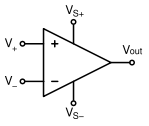
Most existing operational amplifiers are produced on a single semiconductor substrate as an integrated circuit. These integrated circuits are used as building blocks in a wide variety of applications.
Although an operational amplifier is actually a differential-input voltage amplifier with a very high gain, it is almost never used directly as an open-loop voltage amplifier in linear applications for several reasons. First, the gain variation from one operational amplifier to another is quite high and may vary by ± 50% or more from the value specified by the manufacturer. Second, other no idealities such as the offset voltage make it impractical to stabilize the dc operating point. Finally, performance characteristics such as linearity and bandwidth of the open-loop operational amplifier are poor. In linear applications, the operational amplifier is almost always used in a feedback mode.
A block diagram of a classical feedback circuit is shown in illus. a. The transfer characteristic, often termed the feedback gain Aƒ of this circuit, is given by Eq. (1). In the limiting case, as
1. 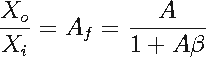
A becomes very large, the feedback gain is approximated by Eq. (2).
2. 
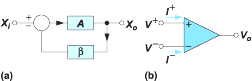
Basic circuits. (a) Classical feedback circuit. (b) Operational amplifier symbol typically used in circuit diagrams.
An operational amplifier is often used for the amplifier designated A in this block diagram. Since Af in the limiting case is independent of A, the exact gain characteristics of the operational amplifier become unimportant provided the gain is large. Although linear applications of the operational amplifier extend well beyond the simple feedback block diagram of illus. a, the applications invariably involve circuit structures with feedback that make the characteristics of the circuit nearly independent of the exact characteristics of the operational amplifier. Such circuits are often termed active circuits.
The commonly used operational amplifier symbol is shown in illus. b. In this circuit, the output voltage is related to the gain A of the operational amplifier by Eq. (3), where A is very
3. 
large and the input currents I+ and I− are nearly zero. |

 )
)